
AI Sales Agent vs Chatbot vs AI SDR: Which One Do You Need?
The three categories overlap, but they solve different sales problems. This comparison helps you choose by workflow instead of label.
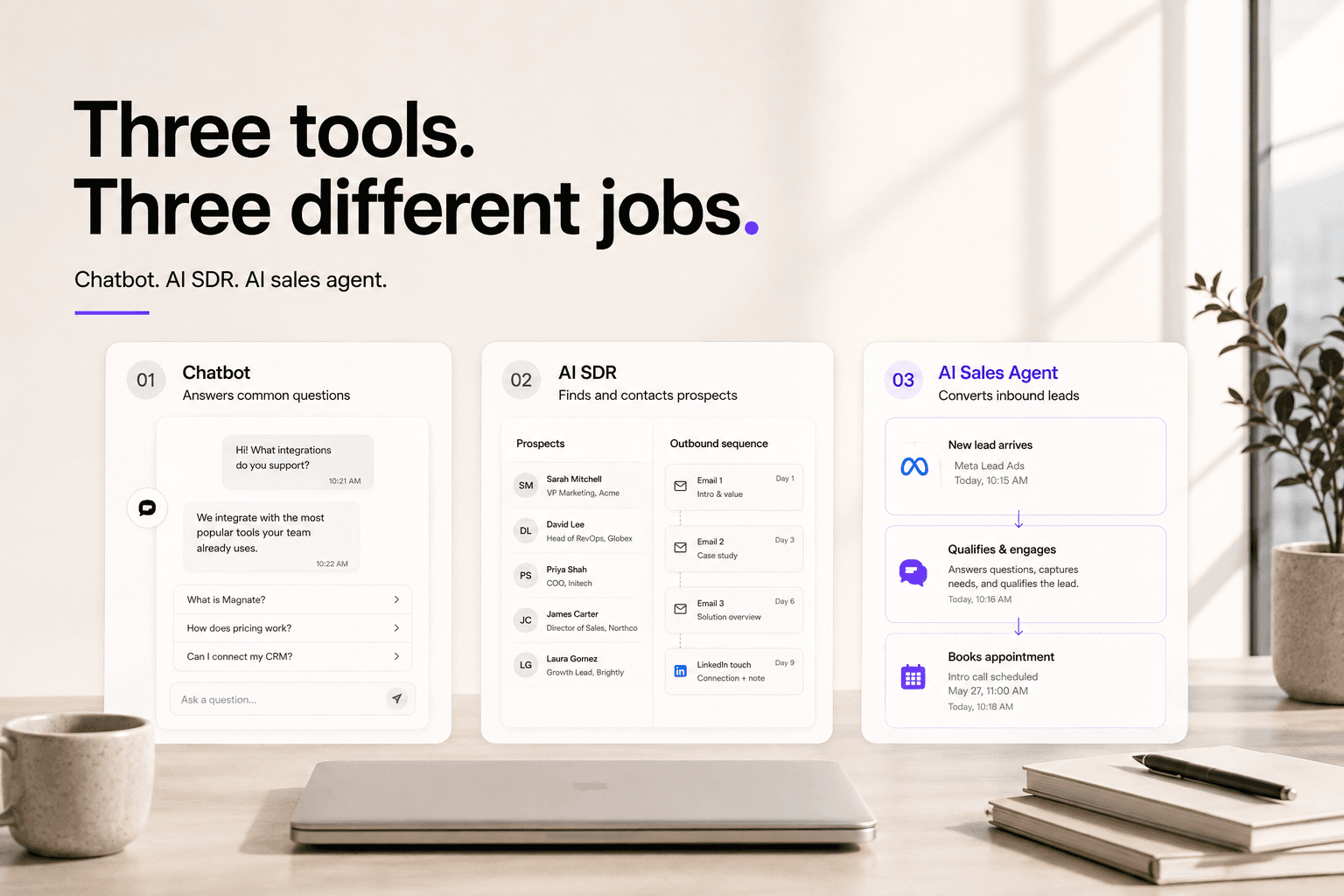
AI sales agent, chatbot, and AI SDR are often used as interchangeable labels. They are not the same role.
A chatbot usually helps a visitor find information or complete a simple path. An AI SDR usually focuses on prospecting and outbound engagement. An AI sales agent manages a sales conversation and the actions that move it toward qualification, booking, nurture, or human handoff.
The boundary is not always clean because products add features from adjacent categories. That is why buyers should evaluate the workflow a system can own, not the category written on its homepage.
Quick comparison
| Question | Chatbot | AI SDR | AI sales agent |
|---|---|---|---|
| Primary job | Answer questions and guide a visitor | Find and contact potential buyers | Move an active sales conversation forward |
| Typical starting point | Website visit | Prospect list or account signal | New inquiry, message, form, or qualified prospect |
| Common motion | Mostly inbound | Mostly outbound | Inbound and follow-up, with outbound support possible |
| Conversation context | Often session-based | Usually account and sequence-based | Lead, source, qualification, and action-based |
| Typical action | Show information or collect a form | Research, personalize, and send outreach | Respond, qualify, follow up, route, book, or escalate |
| Human handoff | Support or sales transfer | Positive-reply routing | Contextual takeover at any point |
| Best fit | Simple questions and navigation | Pipeline creation from target accounts | Converting active demand into the right next step |
What is a chatbot?
A chatbot is a conversational interface that helps a user get information or follow a defined path. It may use buttons, decision trees, natural language, generative AI, or a mixture of these methods.
Common chatbot tasks include:
- Answering website FAQs
- Helping visitors find a page
- Collecting name and contact information
- Opening a support request
- Directing a visitor to sales or support
- Checking a simple status
Chatbots are useful when the scope is clear and the action is limited. A visitor asks a question, receives an answer, and either leaves or reaches another team.
The limitation appears when the sales journey extends beyond the website session. A chatbot may collect a lead but not manage qualification across later SMS, email, or WhatsApp replies. It may also lack ownership of the follow-up cadence, calendar action, lead state, and human takeover.
What is an AI SDR?
An AI SDR is commonly positioned as an automated sales development representative. Its center of gravity is outbound pipeline generation.
Capabilities may include:
- Finding companies or contacts
- Enriching account data
- Researching a prospect
- Drafting personalized messages
- Running email or social outreach sequences
- Detecting positive replies
- Routing interested prospects to a salesperson
An AI SDR is useful when the main problem is identifying and engaging potential buyers who have not submitted an inquiry.
Its quality depends heavily on targeting, data accuracy, message relevance, deliverability, consent and legal requirements, and the rules used to decide when a person is interested. Automating a larger number of irrelevant messages does not create a healthy pipeline.
Some AI SDR products add inbound qualification and scheduling. Others stop at a positive reply. Buyers need to inspect the actual workflow boundary.
What is an AI sales agent?
An AI sales agent is designed to manage an active sales conversation and its next action. The conversation may begin from a lead form, Meta Lead Ad, website inquiry, WhatsApp message, SMS, email, web chat, or a response to outreach.
Its responsibilities can include:
- Starting a contextual response
- Using approved business knowledge
- Answering common questions
- Asking progressive qualification questions
- Updating qualification state
- Running follow-up based on engagement
- Offering calendar availability
- Routing by service, location, or readiness
- Bringing in a person with a summary
The defining characteristic is continuity. The same operating layer keeps the lead source, messages, qualification details, status, next action, and owner connected.
Explore the Magnate AI sales agent to see how these capabilities work together.
Choose based on the problem you need to solve
Choose a chatbot when the main problem is website guidance
A chatbot may be enough when visitors need quick answers, page navigation, basic lead capture, or a simple support path. Keep the scope narrow and make escalation clear.
Ask whether the bot can answer from controlled knowledge, disclose its limits, and pass the conversation with context. Even a simple bot should not invent policies or trap a visitor in a loop.
Choose an AI SDR when the main problem is outbound pipeline
An AI SDR is a better fit when your team has a defined ideal customer profile but lacks time for research and initial outreach.
Evaluate data sources, filtering, duplicate control, personalization quality, deliverability, sequence stop rules, opt-out handling, and how interested replies reach a person. Review a sample of actual target accounts and messages, not only an ideal demonstration.
Choose an AI sales agent when the main problem is lead conversion
An AI sales agent fits when demand already exists, but slow response, inconsistent qualification, missed follow-up, disconnected channels, or manual scheduling causes opportunities to stall.
The system should be able to take an inquiry from first response to a defined state. That state may be qualified and booked, routed to a specialist, placed into nurture, disqualified with a reason, escalated, or opted out.
For teams focused on the first moments after an inquiry, review lead response automation.
Where the categories overlap
A modern platform may perform all three roles in different stages.
For example:
- An AI SDR identifies and contacts a target account.
- The prospect replies with interest.
- An AI sales agent answers questions, qualifies the opportunity, and offers a meeting.
- A chatbot on the website supports later research.
- A salesperson takes over for discovery and the commercial decision.
This can work when identity and context stay synchronized. It becomes risky when separate systems send competing messages, apply different status definitions, or continue automation after a person takes over.
The architecture should define one source of truth for contact permission, current owner, active conversation state, and suppression.
Eight questions to ask in a product evaluation
1. What event starts the workflow?
Determine whether the system begins from a website session, new form, account list, intent signal, inbound message, CRM state, or positive reply. The trigger reveals the category's real center.
2. Which channels can it actually manage?
Listing a channel can mean generating copy, sending a message, receiving replies, or maintaining a full threaded conversation. Ask which level is supported and how consent is represented.
3. Where does business knowledge come from?
The system should use current, approved information for business-specific answers. Confirm how knowledge is added, reviewed, cited internally, updated, and restricted.
4. Which actions can it complete?
Look beyond “automates sales.” List the actual actions: create a lead, send, reply, ask, classify, score, route, schedule, pause, suppress, update, summarize, and escalate.
5. What happens when the answer is unknown?
Test a question outside the knowledge base. A reliable system should acknowledge the limit and follow an escalation rule. Confident guessing is not a feature.
6. How does human takeover work?
Ask whether a person can see the full conversation, take control immediately, stop pending automation, and return the conversation later. Review the context supplied at handoff.
7. How are duplicates and conflicting states handled?
The same person may submit two forms, reply on another channel, or already exist in the CRM. The system needs clear merge, ownership, and suppression behavior.
8. What outcome can the team measure?
The reporting should connect activity to a business state. For an AI sales agent, useful outcomes include qualification completion, booking, show rate, and escalation. For an AI SDR, they include valid contacts, reply quality, meetings, and opportunities. For a chatbot, they include resolution, successful navigation, qualified capture, and transfer.
Risks differ by category
Every category needs controls, but the failure modes are different.
Chatbot risks
- Incorrect answers presented as authoritative
- Visitors trapped without human support
- Session context lost at transfer
- Excessive collection of personal data
AI SDR risks
- Poor targeting at high volume
- Inaccurate enrichment
- Repetitive or misleading personalization
- Deliverability damage
- Outreach that ignores consent or local requirements
AI sales agent risks
- Outdated business knowledge
- Incorrect qualification or routing
- Promises outside approved policy
- Follow-up continuing after reply or takeover
- Sensitive conversations handled without escalation
The mitigation is the same in principle: constrained knowledge, visible rules, observability, testing, stop conditions, and human ownership.
Can one platform replace all three?
It can cover the functions, but that does not mean every business should activate every function at once.
Start with the workflow that has the clearest value and safest boundaries. If active inbound leads are waiting too long, begin with response, qualification, and booking. If the website receives many repetitive questions but few sales inquiries, start with guided support. If the team has a precise target market and strong outbound discipline, consider an AI SDR motion.
Once the first workflow is reliable, connect adjacent stages. Sales automation software should reduce system gaps, not create more overlapping sequences.
Choose the workflow, then choose the label
See how Magnate manages active sales conversations from first response through qualification, booking, and human handoff.
Explore Magnate's AI sales agentFrequently asked questions
Is an AI sales agent better than a chatbot?
It is broader for sales progression, but not automatically better for every use case. A chatbot can be the simpler choice for website navigation and limited FAQs. An AI sales agent is appropriate when the system must maintain context and complete qualification, follow-up, routing, or scheduling actions.
Is an AI sales agent the same as an AI SDR?
No. An AI SDR usually focuses on finding and contacting prospects. An AI sales agent usually focuses on managing an active sales conversation. Products may include both sets of capabilities.
Can an AI SDR handle inbound leads?
Some can, but buyers should verify the depth of inbound support. Check whether the product preserves form context, answers from approved knowledge, qualifies conversationally, manages channels, books meetings, and supports human takeover.
Which option is best for service businesses?
Service businesses with recurring inbound inquiries often gain more from an AI sales agent because the sale depends on response, qualification, routing, and appointment setting. The best choice still depends on the actual bottleneck.
Should these systems disclose that they are automated?
Businesses should communicate in a clear, non-deceptive way and follow the requirements that apply to their market and channel. Do not design an automated system to impersonate a specific person.