
Sales Pipeline Leakage: Where Paid Leads Disappear Before They Buy
Learn where service-business leads fall out of the sales process from slow replies and missed messages to weak follow-up and how to fix each leak.
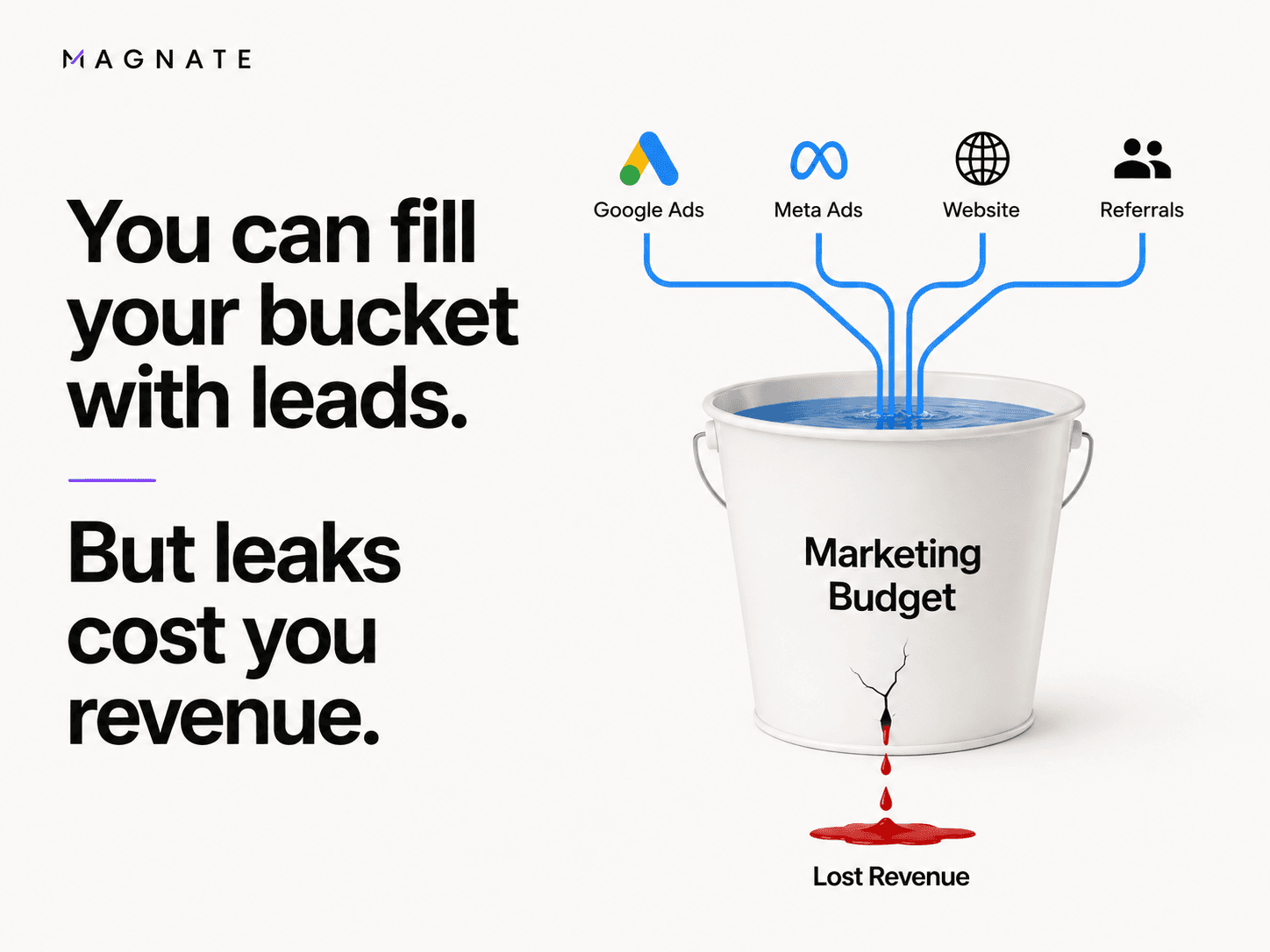
Revenue leakage commonly refers to income a business has already earned but failed to collect. Sales pipeline leakage happens earlier: potential revenue disappears because leads are missed, answered too slowly, poorly qualified or never followed up.
For service businesses investing in Meta Ads, Google Ads and other lead-generation channels, these gaps can make a successful campaign appear unprofitable even when the real problem is what happens after the lead arrives.
1. What is sales pipeline leakage?
Before fixing the problem, it is important to understand the terminology.
| Term | Definition |
|---|---|
| Lead leakage | When a specific prospect is lost due to a process failure before becoming a customer. |
| Pipeline leakage | The cumulative financial impact of all lead leakage across the entire sales funnel. |
| Revenue leakage | Uncollected income from an existing customer or completed sale (e.g., billing errors). |
| Revenue loss | The total potential income lost from any source, including both pipeline and revenue leakage. |
2. The seven places leads leak
Pipeline leaks do not just happen when a prospect says "no". They happen in the silent gaps between actions. Here are the seven most common leaks:
- Lead delivery: The form submission never reaches the correct system.
- Lead routing: No salesperson clearly owns the lead.
- First response: The prospect waits too long for an answer.
- Conversation: A generic autoresponder fails to answer the real question.
- Qualification: The team does not collect the information needed to progress.
- Follow-up: The prospect stops replying and receives no appropriate follow-up.
- Booking and handoff: A qualified prospect cannot easily schedule or reach a human.
3. How to calculate potential lead leakage
To understand the severity of the problem, you need to quantify it. Instead of relying on industry averages, use this formula with your own data:
Potential value at risk = Monthly leads × Unengaged rate × Expected close rate × Average deal value
For example, if you generate 100 leads, fail to engage 40% of them, typically close 20% of engaged leads, and your average deal is $5,000, your potential value at risk is $40,000 per month.
4. A leakage audit
To find where your specific leaks are occurring, audit your process against these metrics:
| Pipeline stage | Metric to check | Warning sign |
|---|---|---|
| Capture | Leads received vs form submissions | Missing records |
| Response | Median meaningful response time | Hours instead of minutes |
| Engagement | Lead reply rate | Generic messages ignored |
| Qualification | Qualified-lead rate | Key information missing |
| Follow-up | Leads receiving the planned sequence | Follow-up stops after one attempt |
| Booking | Qualified leads booking appointments | Too much back-and-forth |
| Handoff | Time from qualification to human contact | Hot leads waiting |
5. The reality of response times and follow-up
An older phone-response study found that the odds of qualifying a lead were substantially higher when the first call attempt occurred within five minutes rather than after thirty minutes. The study measured telephone attempts, so it should be treated as evidence of intent decay not as a guaranteed conversion result for every channel. Original study
(Note: If you want to learn how to structure your response workflow properly, read our guide on speed-to-lead.)
If Meta campaigns are part of your acquisition mix, use this Meta Lead Ads follow-up workflow to close the gap between form submission, qualification, and booking.
6. How AI infrastructure fixes the pipeline
To definitively plug pipeline leaks, throwing more human capital at the problem rarely works. You need active, autonomous infrastructure.
- Instant Execution: Modern AI reduces initial response delay. By capturing leads immediately in a Unified Inbox, inquiries are answered within seconds.
- Contextual Knowledge: Instead of a generic "We will get back to you" auto-responder, AI provides answers grounded in configured company knowledge via Agent Training.
- Intelligent Qualification: It collects qualification information using configured criteria immediately, asking the exact questions your best sales rep would ask.
- Frictionless Booking: It removes the endless back-and-forth emails to find a meeting time via Auto-Scheduling, getting high-intent leads directly onto your calendar.
- Persistent Engagement: Many CRMs require additional workflows or integrations to execute follow-up. An AI sales agent can automatically deploy Smart Cadences so leads never slip through the cracks.
By deploying an AI sales agent, you create an autonomous safety net that reduces preventable leakage.
Find the leaks in your lead-response process
Magnate helps service businesses respond, qualify, follow up and book appointments while allowing a human to take over whenever needed.
Test Magnate with a sample lead