
What Is an AI Sales Agent and How Does It Work?
A practical guide to the role, workflow, guardrails, and business case for an AI sales agent.
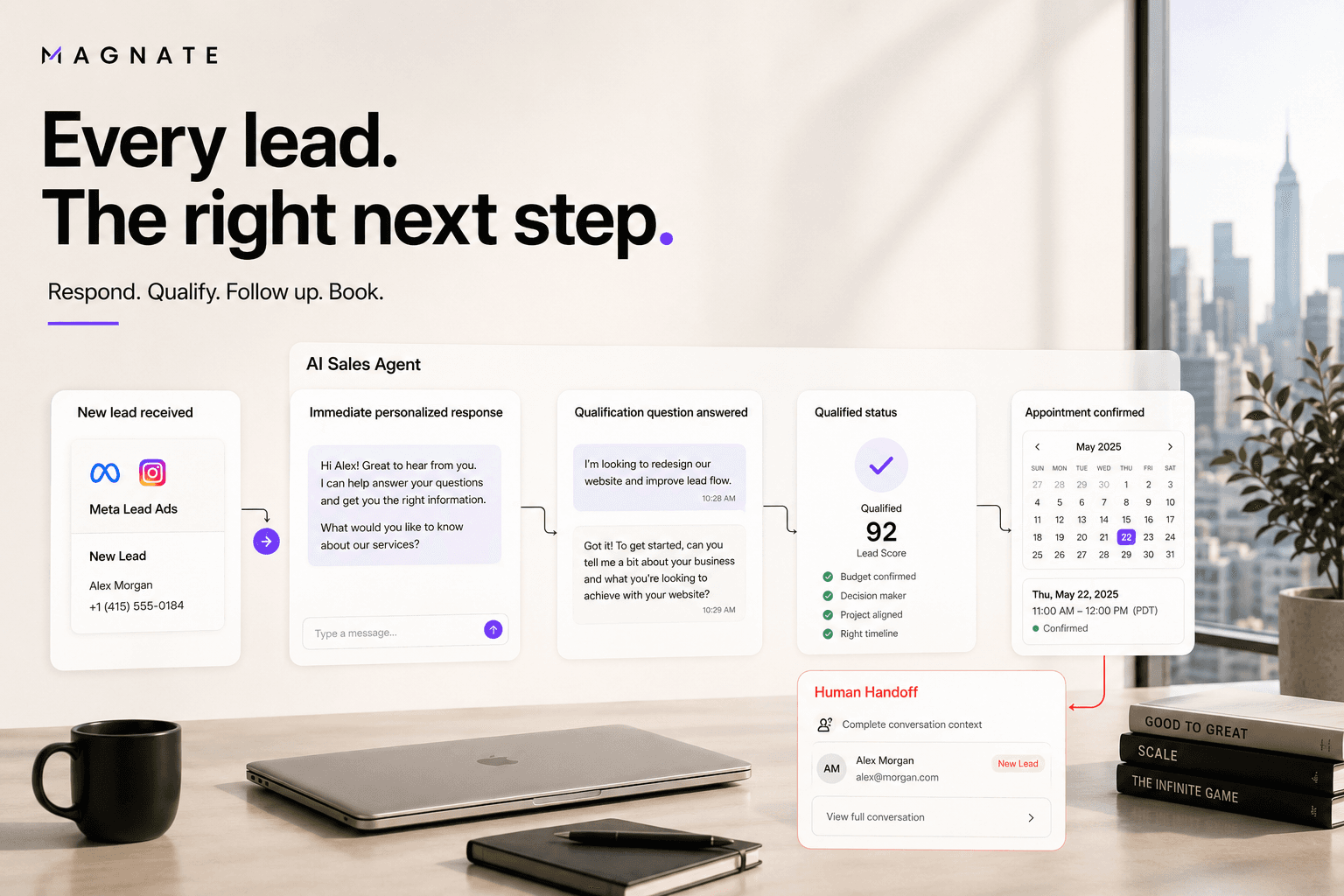
An AI sales agent is software that can hold a sales conversation and complete defined actions within rules set by a business. It can respond to a new inquiry, answer approved questions, collect qualification details, follow up when appropriate, offer available meeting times, and ask a person to take over when the situation requires judgment.
That definition matters because many products described as sales agents perform only one narrow task. A message generator can draft a reply. A chatbot can answer a fixed set of questions. A workflow tool can send a template when a form is submitted. An AI sales agent connects the conversation to the next sales action.
This guide explains how that connection works, where it is useful, and what a buyer should test before relying on it in live customer conversations.
The role of an AI sales agent
The agent operates in the space between a new inquiry and a qualified next step. For many service businesses, that space contains repetitive but important work:
- Confirm what the person requested
- Reuse details already provided in a form
- Answer common questions from current business knowledge
- Ask for missing information needed to determine fit
- Continue follow-up without repeating the full conversation
- Offer the right appointment type when the lead is ready
- Escalate unusual, sensitive, urgent, or unsupported questions
- Record the outcome for the sales team
The role is not to keep a bot talking for as long as possible. It is to help a prospect reach the correct next step with less delay and less manual coordination.
See the complete AI sales agent product overview for the capabilities Magnate connects in one workflow.
How an AI sales agent works
A production workflow has six connected layers. If one layer is missing, the experience often breaks at a handoff.
1. It receives the lead and preserves the source
The process starts when a person submits a form, responds to an ad, opens a web chat, sends a message, or enters through another connected source.
The agent needs more than a name and phone number. Useful context can include the campaign, form, requested service, submitted answers, timestamp, channel, consent record, location, and assigned territory. This information determines how the first response should begin and where the lead should go next.
Without source context, automation often asks questions the person already answered. That creates immediate friction and makes the systems feel disconnected.
2. It uses approved business knowledge
An AI sales agent should not treat the open internet as the source of truth for your pricing, service areas, policies, processes, or availability. Your team should supply and maintain the information it may use.
That knowledge can include:
- Service descriptions and eligibility criteria
- Current pricing guidance and approved disclaimers
- Frequently asked questions
- Service areas and operating hours
- Qualification rules
- Appointment types and preparation instructions
- Tone and communication standards
- Escalation and safety rules
Magnate provides agent training controls so teams can define this business-specific layer.
3. It starts a contextual conversation
A strong first message identifies the business, relates to the original request, and gives the prospect one easy next action.
For example, a person who requested a website redesign should not receive a generic message that says only, “How can we help?” The system already knows why the person made contact. A better response can acknowledge the redesign request and ask for the one missing detail that determines the next step.
Context is not the same as excessive personalization. The message does not need to repeat every field from the form. It needs enough relevance to show that the inquiry was received correctly.
4. It qualifies progressively
Progressive qualification means asking one useful question, interpreting the answer, and choosing the next question based on what is still unknown.
Consider a home services lead. The business may need the service ZIP code, job type, urgency, property type, and ownership status. Sending all five questions in one automated block feels like another form. Asking the most important missing question first keeps the conversation easier to continue.
The agent should also understand ordinary answers. If someone replies, “We are hoping to start next month,” the system should capture a near-term timeline without forcing the person to select an exact predefined phrase.
5. It takes an appropriate action
Qualification should lead somewhere. Depending on the answers, the agent can:
- Offer an appointment
- Route the lead to a location or specialist
- Continue a defined nurture path
- Mark the lead as not currently eligible
- Ask for a human decision
- Stop contact after an opt-out
When scheduling is appropriate, automated appointment booking can remove the back-and-forth of finding an available time.
6. It keeps people in control
The strongest agent is not the one that avoids human involvement. It is the one that knows when human involvement creates a better or safer result.
A handoff should include the original source, form answers, conversation history, qualification state, reason for escalation, and any promised next action. A salesperson should not need to ask the prospect to repeat everything.
A unified sales inbox keeps the automated conversation and the human takeover on the same timeline.
AI sales agent, chatbot, and AI SDR are different roles
The terms overlap in marketing, but they describe different operating centers.
| Category | Primary job | Typical strength | Common limitation | | --- | --- | --- | --- | | Chatbot | Answer website questions or follow a decision tree | Simple support and navigation | Often limited to one surface and fixed paths | | AI SDR | Find, research, and contact prospects | Outbound prospecting at scale | May not own inbound qualification and service workflows | | AI sales agent | Manage a sales conversation and its next action | Connected response, qualification, follow-up, booking, and handoff | Requires accurate knowledge and clear operating rules |
One business may use more than one category. The important question is not which label sounds newest. It is which system owns the customer context and which actions it can safely complete.
For a deeper comparison, read AI sales agent vs chatbot vs AI SDR.
Where AI sales agents are most useful
An AI sales agent creates the most leverage when four conditions are present:
- Leads arrive through repeatable sources.
- The business has clear early qualification criteria.
- Fast, consistent response is operationally difficult.
- Human time is more valuable later in the conversation.
Common examples include home services, agencies, consultancies, real estate, mortgage teams, appointment-led businesses, and multi-location operators.
The exact questions and escalation rules should differ by industry. A roofing company may ask about service location and urgency. A marketing agency may ask about the goal, current approach, timeline, and decision process. A regulated business should reserve more questions and decisions for qualified professionals.
What should never be left undefined
Before an agent speaks with a live prospect, define the boundaries.
Unsupported questions
Decide how the system responds when the knowledge source does not contain a reliable answer. The safe behavior is usually to acknowledge the limit, collect enough context, and escalate.
Sensitive and regulated topics
Identify subjects that always require a person. This may include legal interpretation, medical decisions, financial approval, safety-critical instructions, complaints, or contractual exceptions.
Human requests
If a prospect asks to speak with a person, the workflow should recognize and honor the request. Do not trap the person inside more automated questions.
Opt-outs and quiet periods
Define channel permissions, stop keywords, quiet hours, suppression behavior, and how those preferences are stored. Automation should not continue simply because another scheduled step exists.
Knowledge ownership
Assign a person or team to keep service details, pricing guidance, FAQs, routing logic, and scheduling rules current. An agent trained once and ignored will become less reliable as the business changes.
How to evaluate AI sales agent software
Do not evaluate only the perfect demo path. Use a test set that reflects real conversations.
Ask the system to handle:
- A clear, qualified inquiry
- An ambiguous answer
- A person who changes the requested service
- A duplicate lead from another form
- A question that is not in the approved knowledge
- An urgent or sensitive request
- A direct request for a human
- An opt-out
- A qualified lead when no suitable calendar time is available
- A returning lead with previous conversation history
Then inspect the operational controls:
- Can your team see the source of the response?
- Can it correct business knowledge without engineering work?
- Can a person take over immediately?
- Does the automation pause after a reply or takeover?
- Are qualification states and reasons visible?
- Can outcomes be reported by source, campaign, service, and channel?
The buyer checklist on the AI sales agent page covers knowledge control, workflow depth, human oversight, and channel controls.
Metrics for an AI sales agent
Message volume is not a sales outcome. Measure whether the system creates useful progression.
Operational metrics include lead ingestion success, message delivery, median time to meaningful response, unsupported-question rate, and human takeover time.
Conversation metrics include reply rate, qualification completion, opt-out rate, and the percentage of conversations that reach a defined next state.
Revenue-path metrics include qualified lead rate, appointment-booking rate, show rate, cost per qualified lead, and sales results by original source.
Review these metrics together. A faster first response is not helpful if it creates more opt-outs or routes the wrong people to your team.
Start with one high-value workflow
The best first implementation is usually one repeatable inbound path. Choose a source with meaningful volume, define the expected customer journey, connect the required knowledge and calendar, and test the edge cases before expanding.
A practical first workflow might be:
- Receive a new Meta Lead Ad submission.
- Preserve the campaign and form answers.
- Send a contextual response on an approved channel.
- Ask one missing qualification question.
- Answer supported service questions.
- Offer a meeting to qualified prospects.
- Escalate complex questions with a complete summary.
- Record the final state and source.
Once this path works reliably, the same operating model can extend to other forms and channels.
See an AI sales agent manage the full lead journey
Explore how Magnate connects response, approved answers, qualification, follow-up, scheduling, and human handoff.
Explore the AI sales agentFrequently asked questions
What does an AI sales agent do?
It responds to leads, answers approved questions, collects qualification information, follows up according to engagement, offers appointments, updates status, and escalates conversations within business-defined rules.
Is an AI sales agent a chatbot?
Not in the usual sense. A chatbot often answers questions or follows a fixed path. An AI sales agent maintains sales context and can complete actions such as qualification, routing, follow-up, and booking.
Can an AI sales agent work with human salespeople?
Yes. It is most useful when it handles repetitive early-stage work and gives salespeople a prepared, contextual handoff for conversations that need judgment.
What information is needed to train one?
Provide current service and product knowledge, approved answers, qualification criteria, tone guidance, routing rules, scheduling information, stop conditions, and escalation boundaries.
How long should implementation take?
The timeline depends on the number of sources, channels, integrations, knowledge sources, and exception paths. A focused first workflow is easier to test and improve than a broad rollout that tries to automate every process at once.